How to start a food truck, food trailer or gazebo stall in South Africa
Most mobile food businesses don't fail on the food. They fail because the owner bought the kit first and found out about the certificates second, then spent four months and R40,000 in school fees fixing a setup the health inspector wouldn't pass. This is the order of operations, so you pay for things once.
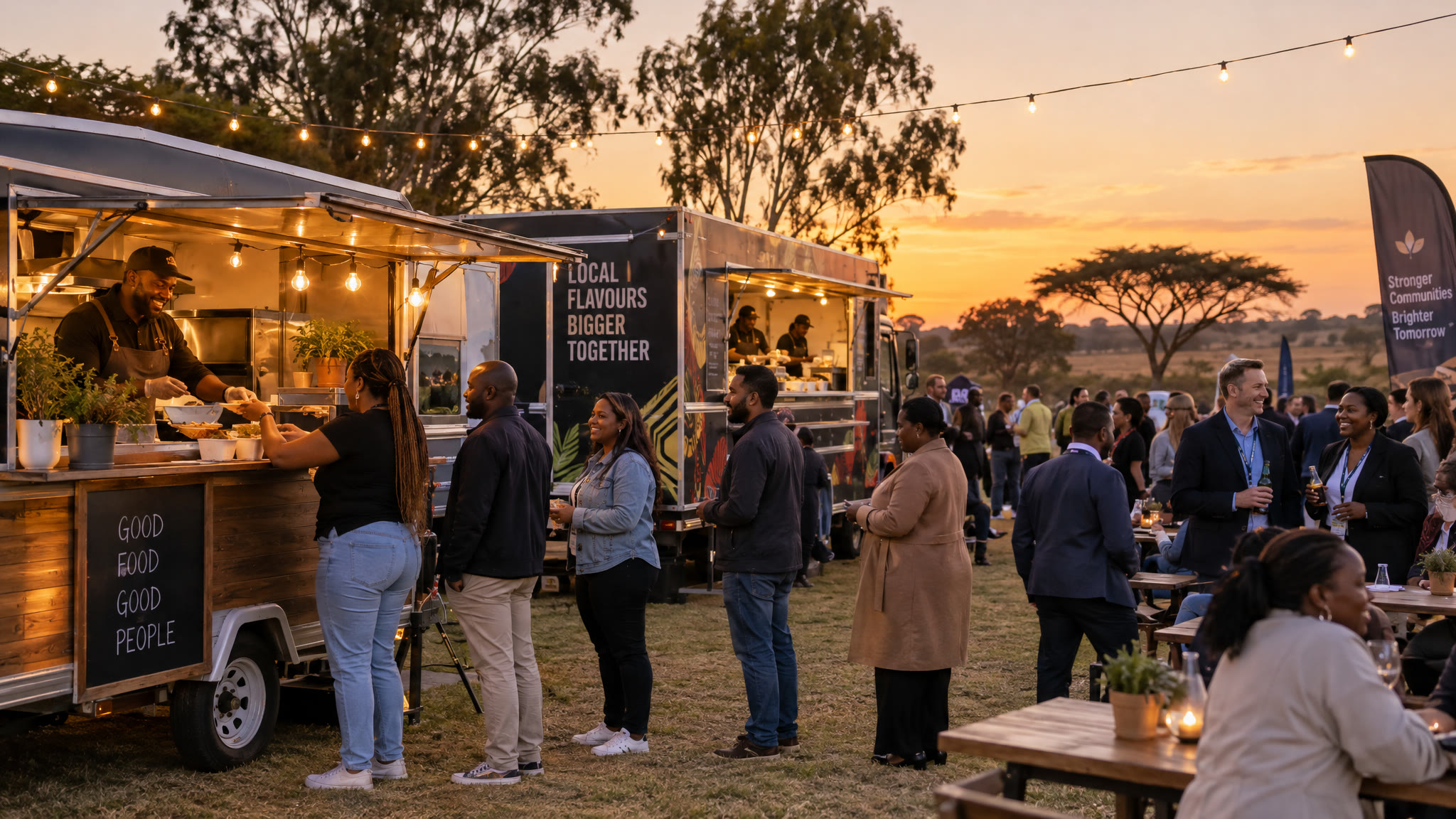
Pick your setup
The rules are mostly the same for all three. The build and the inspection list are not. Pick one and the page shows you only your path.
Showing: Food trailer. Shared rules apply to everyone.
Before you spend a cent
Decide your trading model
It changes everything downstream.
- Events and festivals. Highest margin per day, seasonal, needs organiser approval and a professional look. This is where Howzit Live places vendors.
- Fixed site (office park, forecourt, car wash). Steady weekday trade, needs a landlord agreement and a zoning check.
- Markets. Low entry, tasting-panel approval, weekend-only income.
- Street and public trading. Hawker permit, allocated bay, the most municipal admin.
Most operators who last run events plus one fixed site. Plan for that from day one.
Fix your menu before the build
Five to eight items, maximum. The menu dictates gas versus electric, fridge count, water volume, extraction and hatch layout. A coffee setup and a shisa nyama setup are different animals. Don't buy anything until the menu is costed.
Register the business
CIPC Pty Ltd or sole proprietor. Register for tax. Open a business bank account. Every form that follows asks for these.
The five approvals
These are separate. Having one does not give you another. This is where most people lose money, because they assume the roadworthy or the gas certificate means they can trade.
| # | Approval | Who issues it | What it lets you do |
|---|---|---|---|
| 1 | Trailer registration + roadworthy | Traffic department, via an NRCS-registered builder | Tow or drive it on a public road |
| 2 | Gas Certificate of Conformity (CoC) | SAQCC Gas-registered installer, to SANS 10087 | Legally run LPG appliances |
| 3 | Electrical Certificate of Compliance (CoC) | Registered electrician | Legally run 230 V equipment |
| 4 | Certificate of Acceptability (COA) | Municipal Environmental Health Practitioner, under Regulation R638 of 2018 | Legally prepare and sell food |
| 5 | Trading permission | Municipality (hawker permit), event organiser, or landlord | Legally trade at a specific place |
Plus a Business Licence under the Businesses Act 71 of 1991. Cooked food is Schedule 1, so the municipality requires it. In most metros the COA is a precondition for the licence, so apply in that order. Trading without one carries a fine and, on paper, up to three months in jail.
The sequence that saves money
Register business → cost the menu → build the trailer with gas and electrical certified during the build → apply for COA with both certificates in hand → apply for Business Licence → apply for trading permits per location.
Gazebo operators, read this twice. No vehicle does not mean no compliance. The COA still applies. The gas CoC still applies to your bottle, regulator and hose. The hand-wash basin still applies, as a portable unit. The inspector treats your gazebo as a kitchen because it is one. People lose entire event seasons to this assumption.
The build
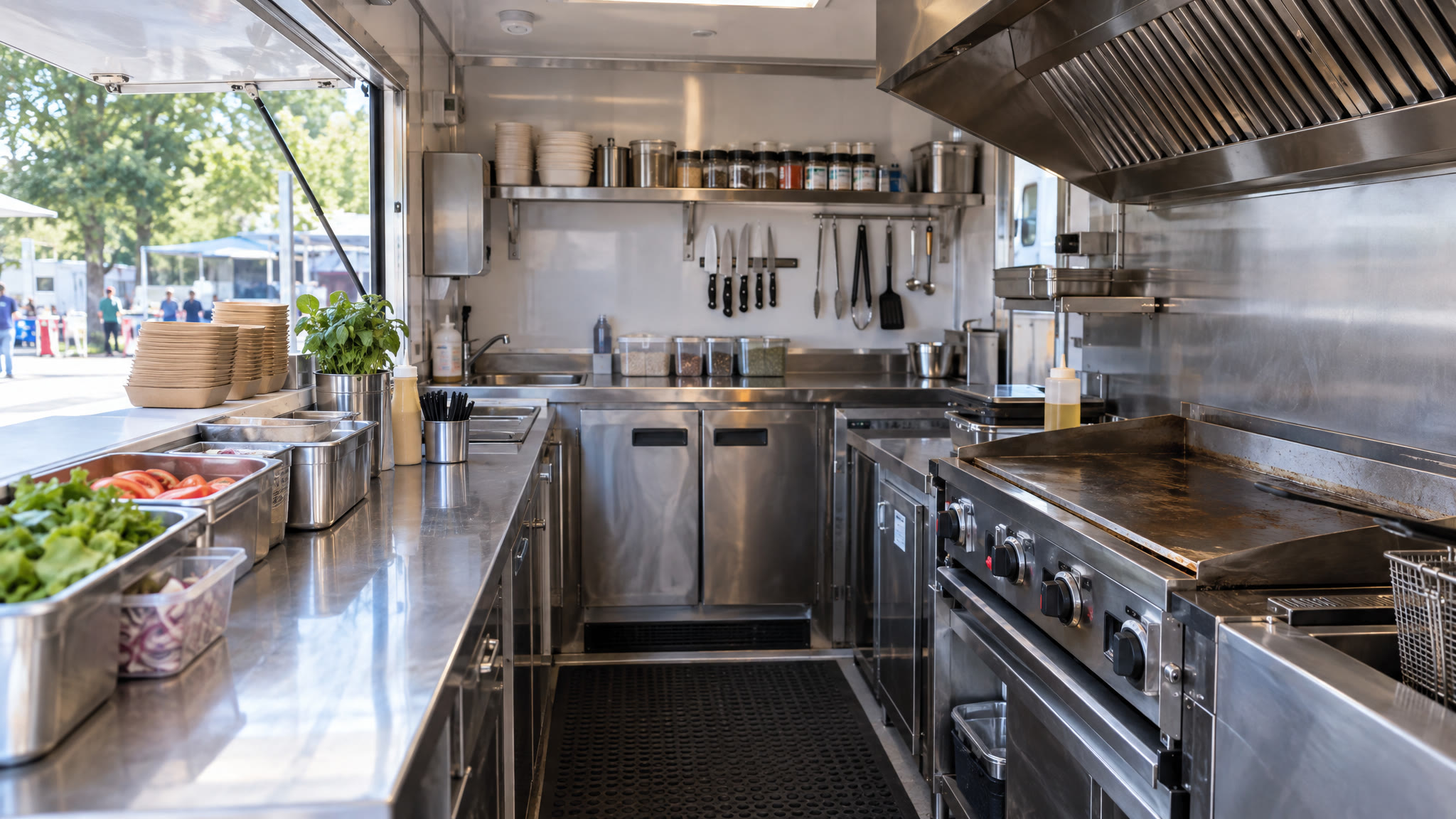
Buy or build?
Buy from an NRCS-registered manufacturer. A self-built trailer must still be homologated by NRCS before it can be registered, and that process costs more than the saving. Reputable SA builders deliver with registration papers and offer gas and electrical CoCs as add-ons. Take the add-ons. It's cheaper than calling installers out afterwards.
Sizes and indicative prices (Gauteng, 2026)
Those are shells with basic fit-out. Equipment, branding wrap and certificates are extra. Budget R25,000 to R80,000 on top for equipment depending on menu.
Converting a vehicle
A panel van, bakkie with canopy or small truck body. The conversion is a modification, so the vehicle must be homologated through an NRCS-registered converter before the traffic department will re-register it as a mobile catering unit. Do not let a general panel beater do this. Insurers will refuse the claim and the inspector will refuse the COA.
Indicative costs (2026)
A truck costs roughly double a trailer and needs a licensed driver with the right code every day. In return you set up in ten minutes and don't need a tow vehicle.
The kit
Cheapest entry by far, and the one with the most hidden compliance. Budget R18,000 to R45,000 for a setup that passes.
Non-negotiable build specs
These are what the EHP checks, so build them in from the start.
- Interior surfaces smooth, non-absorbent and washable: stainless or sealed Chromadek. No raw wood, no exposed chipboard.
- Potable water tank or containers, 60 to 100 l for a day's trade, with a sealed fill point, plus a separate grey-water tank of equal or larger capacity.
- Two sinks minimum. A dedicated hand-wash basin with soap and paper towel, separate from the prep and wash sink. This is the single most common fail.
- Hot water to the sinks: small under-counter geyser, gas instant unit, or an urn for a gazebo.
- Extraction canopy over cooking equipment, vented outside.
- Fridge and freezer that hold 5 °C and –18 °C under load, with a thermometer in each.
- Fire extinguisher (4.5 kg dry powder minimum for gas kitchens) plus a fire blanket, mounted and serviced.
- Gas bottles outside the body in a ventilated, locked cage. Never inside.
- Serving hatch with fly screens or a closable window; food displays covered.
- Lighting over every work surface with shatterproof covers.
- Closed waste bin inside, closed bin outside.
- Floor sealed to the walls, no gaps.
Gas (SANS 10087)
Only a SAQCC Gas-registered installer may install and certify. The CoC is in your name and your trailer's registration number. Get the installer's SAQCC number on the certificate. Insurers will ask for it.
Electrical
A registered electrician issues the CoC. Specify an earth-leakage unit and a proper 16 A or 32 A inlet so you can plug into event power safely. Event organisers will ask what your draw is. Know your amps.
What the health inspector actually checks
The Environmental Health Practitioner inspects two places: your trailer and the kitchen where you prep and store stock (your commissary). Both must pass. A home kitchen can pass, but only if it's separated from household use and meets the list below.
On the trailer
- Hand-wash basin: present, separate, soap, paper towel, running water
- Potable water: source, storage, fill point sealed
- Grey water: contained, not draining onto the ground
- Surfaces: intact, cleanable, no damage
- Temperature: fridge thermometers, high-risk foods at or below 5 °C, hot-hold above 60 °C
- Food covered and off the floor
- Pest evidence and a pest-control contract or certificate
- Waste: lidded bins, removal plan
- Fire extinguisher and blanket, serviced and in date
- Gas CoC and electrical CoC on hand
- Protective clothing: headgear minimum, clean aprons, no jewellery on hands
- Person-in-charge training certificate on hand
- Chemicals stored separately from food
- Gazebo: weighted legs, fire-retardant certificate, sealed floor covering, sides fitted, gas bottle outside the cooking zone
- Truck: generator exhaust routed away from the hatch, fuel stored outside the kitchen body, engine off while trading
In the commissary kitchen
- Cleanliness, ventilation, lighting
- Raw and cooked storage separated, raw meat below cooked
- Dry store off the floor, sealed containers, dated
- Fridge and freezer temperatures logged
- Hand-wash facilities
- Pest control
- Waste management
- Equipment and utensils clean and food-safe
- No pets, no household overlap during prep
The seven fails, in order
- One sink doing everything — hands and food in the same water
- No thermometers, or no temperature records
- Grey water draining on the ground
- Gas bottle inside the trailer
- No pest-control proof
- Wood or damaged surfaces
- Nobody on site with a food-safety certificate
Fix those seven before you call the EHP and you'll likely pass first time. Every re-inspection costs you weeks and sometimes a re-inspection fee.
Training
Regulation R638 requires the person in charge to hold recognised food-safety training. Options: online self-paced (about R1,500 to R2,500), two-day virtual, or two-day classroom. Train at least two people so you can trade when one is off. Keep certificates in a folder on site with the CoCs, COA and business licence. Inspectors and event organisers both ask.
Trading permissions
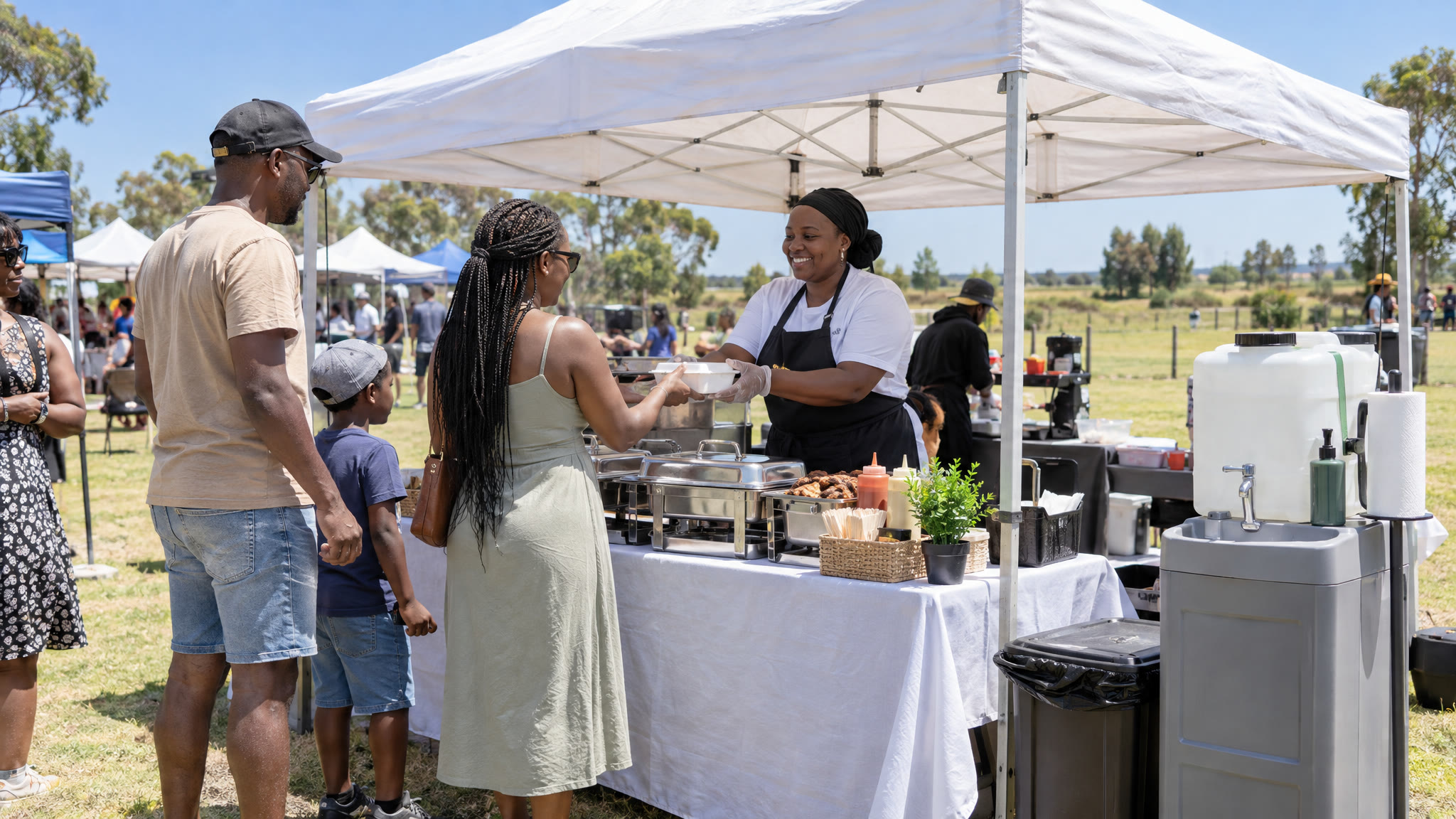
Events
The organiser issues a vendor permit for that event only. They'll want your COA, gas CoC, public liability insurance, menu, photos of your trailer and your power draw. Howzit Live vendors upload these once to their profile so organisers can approve faster.
Markets
Apply to the market operator. Most run a tasting panel and want a COA and a non-competing menu.
Private sites
Written agreement with the landowner. Check the municipality for zoning: some office parks are zoned so that food sales need a consent use.
Public streets
A hawker or informal trading permit from the municipality, with an allocated site. Johannesburg and Cape Town require the COA and business licence before they'll allocate a bay, and first-time applicants may have to attend an information session.
Not having a trading permit for a spot is the quickest way to get fined and moved on, COA or not.
Insurance
- Public liability. R2 to R5 million is typical for events; most organisers require proof.
- Trailer insurance. Towed and parked, with contents.
- Vehicle insurance declared as a converted catering unit, with contents. An undeclared conversion voids the policy.
- Equipment and stock cover for theft and weather damage. Gazebos go missing from markets.
- Gas and fire cover confirmed in writing. Insurers may decline claims without a valid SAQCC CoC.
- Stock spoilage if you carry high-value cold stock.
The numbers
Build a break-even before launch. Worked example: a mid-size burger trailer.
A R65 burger at 32% food cost nets about R44 before pitch fee, labour and packaging. At 120 burgers on a good event day that's R5,280 gross profit, about R3,000 after a R1,500 pitch fee and one assistant. Three events a month covers your trailer finance and insurance. The fourth, and every fixed-site weekday, is profit. Know these numbers before you sign for anything.
A gazebo setup cuts the finance line to near zero, so your break-even is two events a month. The trade-off is slower setup, weather exposure, and organisers placing you behind the trailers.
A truck roughly doubles the finance line. Your break-even is five to six events a month, or a fixed weekday site plus weekends. Don't buy a truck on event income alone.
Launch checklist
Tick them off. Copy the list to keep it.
Where to get help
Links are being confirmed. Howzit Live only lists providers we've spoken to.
Online, virtual and classroom options
Gauteng and Western Cape
Search the register at saqccgas.co.za
Compliance check
Twelve questions. 70% to pass. The certificate shows you did this properly; organisers like seeing it on a vendor profile.
This certifies that
completed the Mobile Food Vendor Compliance Check for a food trailer setup with a score of 0% on .
Screenshot this for your vendor profile.
Get listed
Event organisers on Howzit Live search for compliant vendors first. Create your vendor profile, upload your compliance folder once, and get matched to events.
This guide is general information for South African mobile food vendors and is not legal advice. Regulation R638 of 2018, SANS 10087 and municipal by-laws are the authorities. Prices are Gauteng indications as at Oct 2026.